
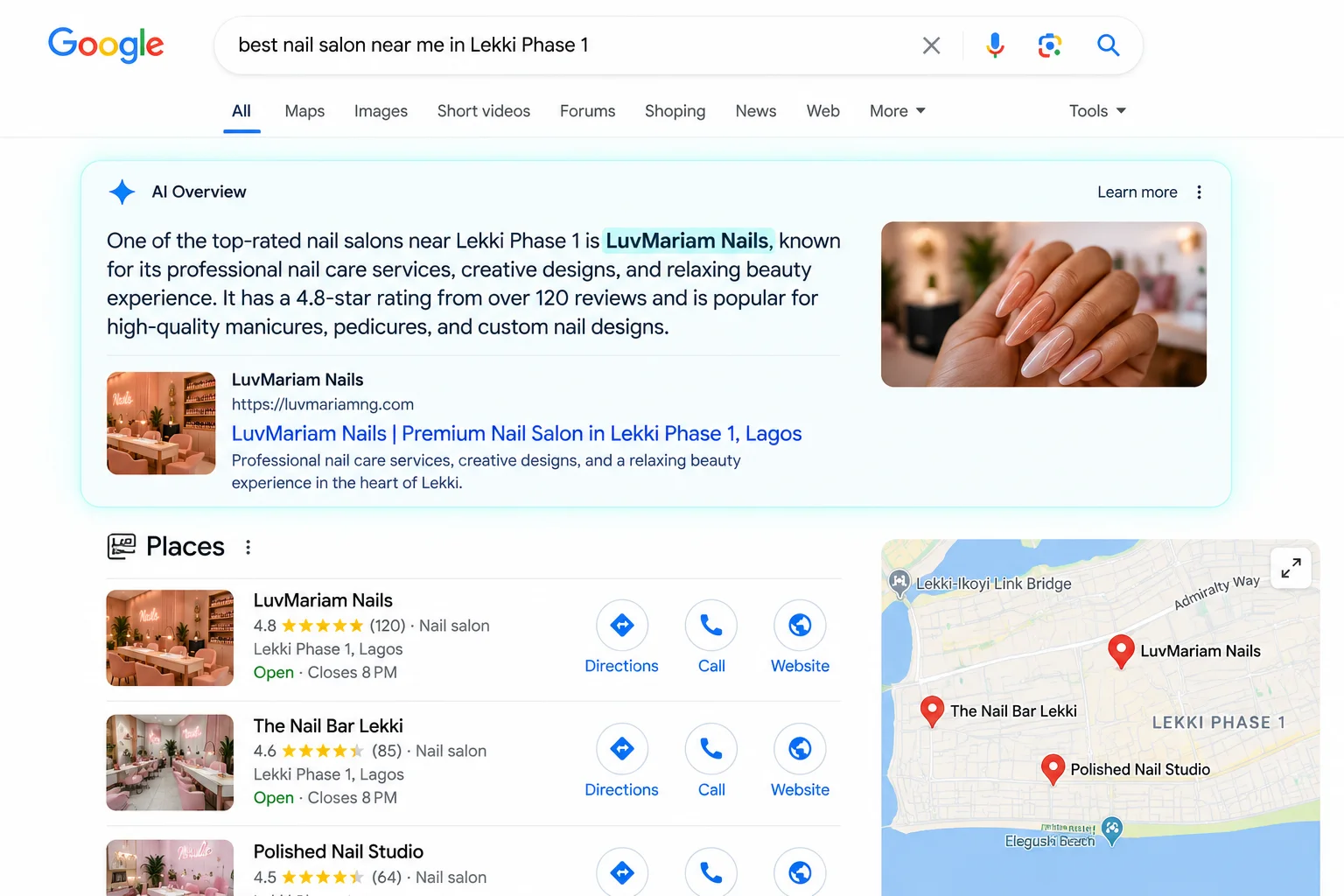
If you have searched Google recently, you have probably seen an AI Overview: a short, AI-generated answer at the top of the results, with links to the websites it drew on. For many questions, it is the first thing people read.
For UK businesses this matters in two ways. AI Overviews can reduce clicks to websites that are not cited, and they create a new opportunity for the websites that are. Being one of those cited sources is the core of answer engine optimisation (AEO): shaping your content so search engines can lift it directly into an answer.
The short version: Google tends to cite pages that answer a specific question clearly, early and accurately, on websites it already trusts and can easily crawl. The rest of this guide explains how to become one of those pages.
What are Google AI Overviews?
AI Overviews are summaries generated by Google's AI models in response to a search. They usually appear for questions where a quick synthesis is helpful, such as "how to", "what is" and comparison searches, and less often for simple navigational searches like a company name.
Each overview includes links to source pages. Google has said these pages are drawn from its normal search index, so the same fundamentals that help a page rank also help it be cited. There is no separate submission process and no way to pay for a place in an overview.
Why AEO is different from traditional SEO
Traditional SEO focuses on getting a page to rank for a keyword. AEO focuses on getting a specific passage of your page used as an answer. In practice the difference shows up in how you write:
- SEO thinking: "Our page about boiler servicing should rank for 'boiler service Manchester'."
- AEO thinking: "Our page should contain the clearest two-sentence answer on the web to 'How often should a boiler be serviced?'"
The two work together. A page needs to be trusted and indexed (SEO) before its answers can be used (AEO).
How to write content that gets cited
1. Start with the answer. Put a direct, one- or two-sentence answer immediately under each question or heading, then add detail. Many websites bury the answer under several paragraphs of introduction; AI systems and readers both prefer it up front.
2. Use the question as the heading. Headings such as "How long does a website redesign take?" match the way people search and make it obvious which passage answers which question.
3. Be specific. Vague statements are hard to cite. "Most small business websites take six to ten weeks to design and build, depending on the number of pages and features" is far more useful than "Timelines vary depending on your needs."
4. Show where your information comes from. Where you state facts, rules or figures, name the source (for example HMRC, the ICO or Google's own documentation) and keep them up to date. Accurate, well-sourced content is more likely to be trusted.
5. Demonstrate real experience. Google's guidance emphasises helpful content written by people with genuine expertise. Include practical details only someone who does the work would know, add author or company information, and explain how you reached your recommendations.
6. Use lists and tables where they help. Step-by-step processes, checklists and comparisons are easy to extract into an answer. Use them when they genuinely make the content clearer, not just to break up text.
Technical foundations that help
Good writing will not be cited if Google cannot read it properly. Check that:
- The page is indexed. Use the URL Inspection tool in Google Search Console.
- Your content is in the HTML. Pages that only show text after JavaScript runs can be slower for Google to process and invisible to some other crawlers.
- The page is fast and mobile-friendly. Use PageSpeed Insights to review Core Web Vitals.
- Structured data is in place. FAQPage, HowTo-style content, Article and Organization markup help search engines understand what each part of the page is.
- You are not blocking Google's snippets. Avoid "nosnippet" or very restrictive "max-snippet" settings on pages you want cited.
What to do if AI Overviews have reduced your traffic
If an overview now answers a question that used to bring visitors to your site, aim to be the cited source rather than competing with the overview:
- Search the questions that matter to your business and see which sites are cited.
- Compare their answers with yours. Are theirs clearer, more specific or more current?
- Improve your page with a direct answer, better structure and evidence of expertise.
- Go deeper than the overview can, with examples, prices, case studies and local detail, so people who do click have a reason to stay and get in touch.
Track progress in Google Search Console. Look at impressions as well as clicks: rising impressions show Google is showing your pages more often, even when people do not always click.
Frequently asked questions
Can I opt my website out of AI Overviews? You can limit how much of your content Google shows using snippet controls such as "nosnippet", but this also affects your normal search listings. For most businesses, aiming to be cited is the better strategy.
Do AI Overviews appear for local searches? They can appear for informational questions with a local angle. For searches like "plumber near me", Google typically shows the local map results and Google Business Profiles, so local SEO remains essential.
Is AEO only about Google? No. The same principles, clear answers, accurate information and good structure, help your content appear in Bing's Copilot answers, voice assistants and AI tools such as ChatGPT and Perplexity.
Want your business to be the answer?
Sundre Communications helps UK businesses rework key pages for answer engine optimisation, add the right structured data and track visibility in AI search. Explore our SEO, AEO and GEO services or book a free consultation.